
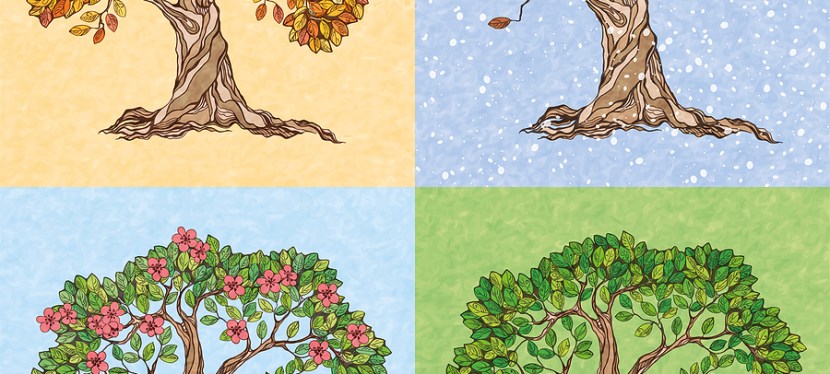
Palmer wraps up his book by looking at selfhood and vocation through the metaphor of the seasons.
He starts with autumn – a season that looks like decline but is a season for the scattering of seeds for the growth that will appear with great abundance in the spring. In the autumns of our lives, we encounter what initially looks like failure – a lost job, a failed relationship, a door closed to us. It will take retrospect to see that the “death” was necessary for the blooming of a new opportunity.
Winter, says Palmer, looks and feels like death: “few creatures stir, plants do not visibly grow, and nature feels like our enemy” (pg 101). But nature is not dead; it merely has gone underground to renew itself and prepare for the growth of spring. We are admonished to do the same for ourselves. Our inward winters, says Palmer, take many forms -failure, betrayal, depression, death. In the Midwest, it is said, “the winters will drive you crazy until you learn to get out into them” (pg 103). In the same way, we must enter boldly into the fears we most want to avoid and learn what they have to teach us or they will dominate our lives.
The season of spring begins in muck and mess but that turns out to be fertile soil for spring to give herself away with abandon. The lesson for us is to pay attention to the hunches and intuitions in our lives, for they may be openings for important things to bloom. Spring, says Palmer, teaches us to give ourselves away. “If we want to save our lives, we cannot cling to them but must spend them with abandon” (pg 105).
Summer, we find, is about abundance. This, says Palmer, is in sharp contrast to living with the mentality of scarcity that pervades so much of human life. Too often too many live as if there is not enough to go around. I must keep my share and more so that I will have sufficient, even though I see poverty all around me. “It is difficult to trust that the pool of possibilities is bottomless, that one can keep diving in and finding more,” says Palmer (pg 107). But that is how we are called to live, and it is best done in community. Abundance is a communal act, says Palmer. “It is created when we have the sense to come together to celebrate and share our common store” (pg 107).
For reflection
Thinking about the life that has brought you to where you are today, when has each of these seasons been prominent? You might want to draw a timeline of your life and identify the seasons you recognize. What lessons did you learn from each of them?
What season are you in just now? Is it where you want to be?
As you review the entire book, what is one take-away from each chapter that you can use as a guide for your remaining years?

More resources
Make Your Gifts Your Prayer
What are your gifts? asks Brother Lain Wilson of the Society of St. John the Evangelist. “You are uniquely you, and so are your gifts,” he says. What will you do with your gifts? What fruit will come them?
Read or listen. Click the title below.
 The Wisdom Years